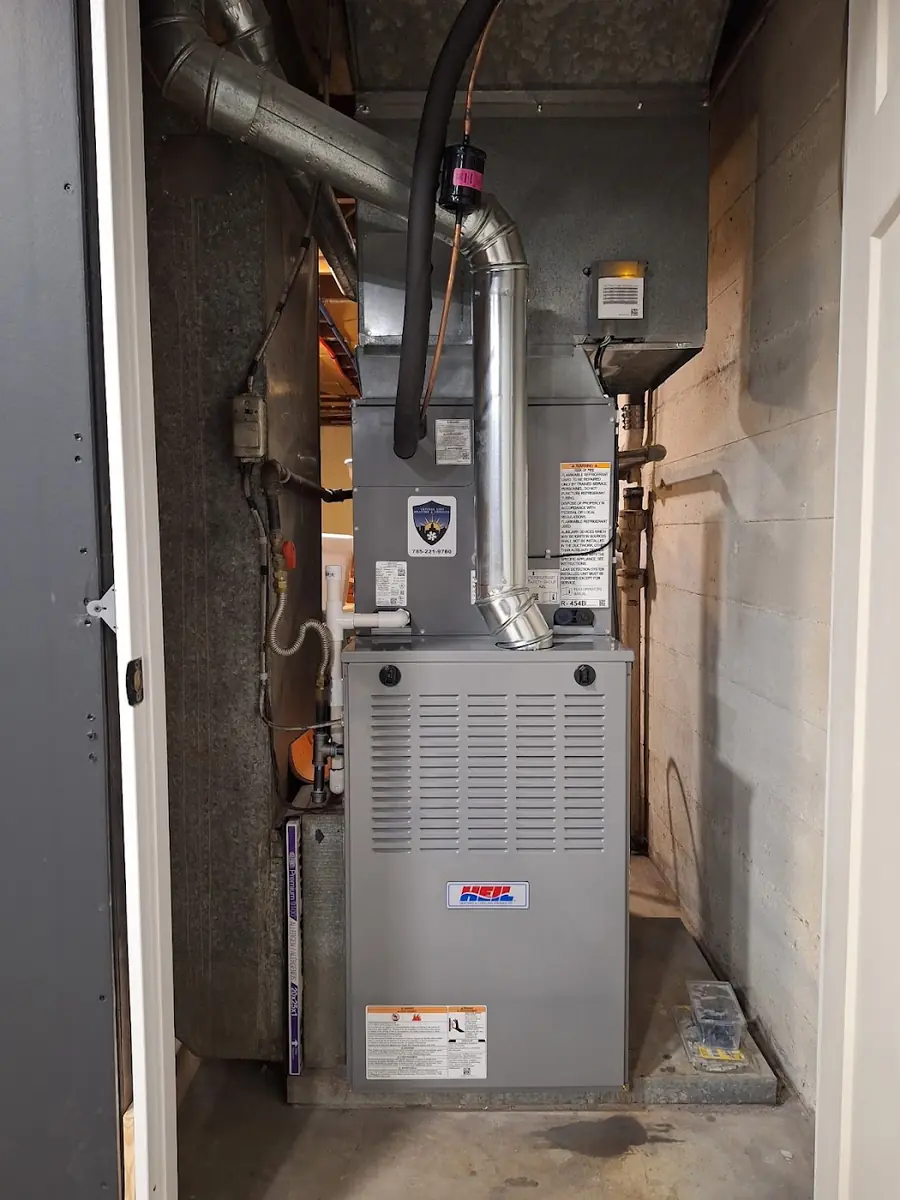
Why winter air feels so dry
Cold air outside holds very little moisture. When a furnace heats that air to room temperature, the relative humidity drops. Relative humidity is the amount of moisture in the air compared with the most it could hold at that temperature, and warmer air can hold more. Heating the air does not pull water out of it. The same moisture simply makes up a smaller share of what the air could carry, so the air feels dry.
People notice it as rough skin, dry lips, static shocks and a scratchy throat. Wood floors and trim can also react to very dry air by shrinking slightly and showing small gaps. A whole-house humidifier adds moisture back into the air your furnace sends through the ducts, so every room gets some, not just the one with a portable unit.
How a whole-house humidifier works
A whole-house humidifier attaches to the furnace or its ductwork. Designs differ. Some pass air across a water-soaked pad, some use a rotating drum, and some spray a fine mist. In each case the warm air leaving the furnace picks up moisture and carries it through the house.
The unit needs a water supply and a way to drain or manage excess water, and the pad or drum is a wear item that needs replacing on a schedule set by the manufacturer. We service whole-house humidifiers. If yours is not working, or you are not sure whether it is doing anything, call us and a technician can look at it.
Follow your humidifier's manual for settings. Most people are comfortable with indoor humidity between 30 and 50 percent. In winter, watch your windows. If you see condensation or water beading on the glass, the humidity is too high for the outdoor temperature, and you should turn the humidifier down. Too much moisture can lead to mold and damaged window frames.
Air filters and how often to change them
Your furnace and air conditioner share one blower, the fan that moves air through the house, and every time it runs it pulls air from your rooms through a filter before the air reaches the equipment. The filter catches dust, pet hair and larger particles. It protects the equipment as much as it cleans the air, because a coated filter restricts airflow and makes the system work harder.
Check the filter every month. If it looks gray or clogged, replace it. How often a filter needs replacing depends on its type, the manufacturer's directions and your home. Pets, shedding, dusty work nearby and heavy use in summer or winter all load a filter faster.
Filters also differ in how fine a particle they catch. A thicker, denser filter catches smaller particles but also resists airflow more, and some systems struggle with that. Before you switch to a denser filter, check that your equipment is designed to handle it. Ask us if you are unsure which filter suits your system. Turn the system off before you pull the old filter, and match the airflow arrow on the new filter's frame to the direction air moves through the equipment.
Dust in your home, and where it comes from
Dust has several sources. Skin flakes, pet dander, fabric fibers, pollen carried in on shoes and clothes, and dirt that comes in through doors and windows all settle indoors. Cooking and cleaning stir it up again.
The heating and cooling system can add to the problem. A filter that is clogged or too loose for the job lets dust pass through to the blower and ducts. Return ducts, the ducts that bring air back to the equipment, can draw in dusty air from a crawl space, attic or wall cavity if they have gaps or loose joints, because the return side of the system pulls air in. A technician can inspect the system for these problems.
We service filters and ductwork, so we can check the system side. We cannot remove the dust that comes from the way a house is lived in. If you see dust building up quickly on surfaces even though you clean often, call and we can look at the filter, the return side and the ducts.
Thermostats and heating and cooling schedules
A thermostat tells your furnace and air conditioner when to run. An old one can be inaccurate, hard to read, or poorly matched to how your household uses the home. We can help with thermostats.
A programmable or smart thermostat lets you set different temperatures for different times of day. The Department of Energy notes that setting the temperature back while you are asleep or away can reduce energy use. Pick a schedule you will actually keep, because a schedule that fights your routine gets overridden.
Large swings can also leave you waiting for recovery. On a hot afternoon, an air conditioner needs time to bring a warm house back down. If you set the temperature back, give the system time to catch up before you decide something is wrong.
Rooms that stay too hot or too cold
One room that never matches the rest of the house is a common complaint. Several things can cause it. The duct serving that room may be long, small, crushed or leaking. The room may have more windows, more sun, or less insulation than the others. Airflow does not divide evenly among the branches of a duct system, so some rooms get more than others by the way the system is built.
A damper is an adjustable plate inside a duct. Closing it partway reduces the air to that branch and opening it sends more. Dampers can help balance airflow between rooms, and they are one of the services we offer. Settings that help in winter often need changing in summer, so balance takes some adjusting over a season.
Also check the basics. Make sure furniture, rugs and curtains are not covering vents, and that interior doors are not shutting a room off from a path for air to return to the equipment. If the problem remains, a technician can inspect the ducts.
When to call about air quality and comfort
Call if the air in your home stays dry all winter, if dust builds up fast, or if rooms stay too hot or too cold no matter what the thermostat says. Call if your humidifier is not running, or if you see condensation on the windows and cannot bring the humidity down.
If you smell gas or your carbon monoxide alarm sounds, leave the home and call 911 or the gas company from outside. Do not call us first. Those are emergencies, not comfort problems.
Humidity and your home
Air that is too dry feels uncomfortable and can dry out wood and skin. Air that is too humid can fog windows and support mold growth. Most people are comfortable between 30 and 50 percent humidity, and the humidifier's manual will tell you how to set it. If you see condensation on windows, lower the setting.
If anyone in the home has allergies, asthma or another health condition, ask their doctor what indoor air conditions suit them.
Filters and allergens
Some filters are made to catch finer particles, such as pollen and pet dander. A better filter can help, but it has to fit your system and be replaced on schedule. Ask us which filters your equipment can use without choking the airflow.
Photos from our jobs