
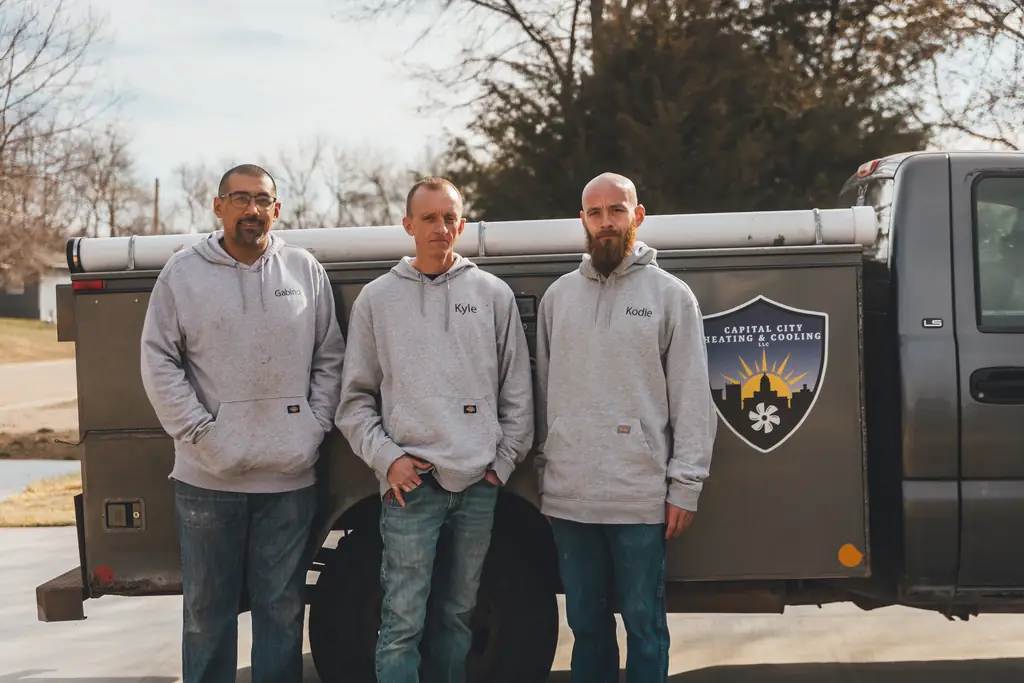
By Kyle Smith's crew at Capital City Heating & Cooling, Topeka, KS. 7 minute read.
When to replace your furnace depends on its condition, repair history and ability to heat your Topeka home safely. Furnaces typically last about 15 to 20 years. Use that range to plan an inspection and review your options. A technician needs to identify the problem before you can compare a repair with replacement.
When to replace your furnace in Topeka
Consider replacement when a major repair would leave you with other worn equipment or when restoring safe operation requires extensive work. Ask what failed and what condition the rest of the furnace is in. A recurring shutdown can come from an unresolved airflow problem, so repeated interruptions need a diagnosis.
Gather earlier repair records and the installation date if you have it. Tell the technician whether the furnace struggles throughout the home or only in certain rooms. Include changes such as a finished basement or an addition. Those changes can affect how much heat you need and where it needs to go.
An older furnace that heats reliably still needs its condition assessed. A newer furnace with repeated faults needs the same attention. Age helps put repair costs in context, but the inspection establishes what work is needed now.
What are signs my furnace is failing?
Repeated shutdowns, new noises and weak heat are reasons to arrange an inspection. Describe what happens from the time the thermostat calls for heat. Note whether air reaches the rooms and whether the furnace stops before the home reaches the setting. You can observe this without opening an equipment panel.
The blower is the fan that pushes air through the furnace and ducts. It normally starts after the burners light and can keep running after they stop. That timing moves remaining heat into the rooms. A brief period of cooler airflow at the end of a cycle does not by itself prove a failure.
Rattling, squealing or banging suggests something needs attention, but a sound cannot identify the failed part on its own. Leave internal checks to a technician. If you smell gas or hear a carbon monoxide alarm, leave and call 911 or the gas company from outside. Carbon monoxide is a poisonous gas you cannot see or smell. For a burning smell, sparks or signs of electrical trouble, leave and call 911 from outside.
Does a cracked heat exchanger mean I need a new furnace?
A cracked heat exchanger requires the furnace to stay off until a qualified technician resolves the safety problem. The heat exchanger separates combustion gases, produced when fuel burns, from the air circulated through the home. Damage can compromise that separation and create a carbon monoxide hazard.
A technician can sometimes replace the heat exchanger. The choice depends on the furnace's condition, available parts and the work involved. Ask how the damage was identified and what each repair or replacement option includes. Do not restart a furnace that a technician has shut down as unsafe.
Visible rust does not prove that the heat exchanger is cracked or that fuel is burning incorrectly. Moisture has several possible sources, and a technician needs to trace it. Soot, a black residue from incomplete burning, also needs professional attention. Leave the furnace off until the technician has checked the cause.
Can airflow problems cause uneven heating?
Restricted airflow and duct problems can leave rooms cold even when the furnace produces heat. Ducts carry heated air from the furnace and bring room air back. A blocked filter can restrict that circulation. Leaks can let heated air escape before it reaches the rooms.
Turn the system off at the thermostat before checking an accessible filter. Follow the equipment manual for its type and replacement interval. If reaching it requires opening an equipment panel, leave that check to a technician. Keep furniture clear of supply vents and return grilles, the openings that deliver air and draw it back.
Tell the technician if a room gets colder when its door closes. Air needs a path back to the return grille, though each room does not necessarily need a dedicated return vent. A damper, a movable plate inside a duct, can also affect airflow. Leave diagnosis and adjustment of the duct system to the technician.
How should I compare furnace repair and replacement costs?
Compare the specific repair with a replacement installation that addresses the home's heating needs. Ask whether the repair restores safe operation and whether the inspection found other worn parts. Previous repairs help explain the history, but money already spent cannot predict the next failure.
Review heating bills alongside fuel rates, weather and thermostat settings. Higher bills alone cannot establish that the furnace has lost efficiency. Changes in insulation or air leaking around the home can also affect heating demand. Any estimate of energy savings needs to account for those conditions and the proposed equipment.
We provide a written estimate before installation work starts. Replacement cost depends on the furnace, access to the equipment and any necessary changes to connections or ducts. Ask what the installation includes so you can compare the proposed work with the repair you are considering.
What does replacing a furnace involve?
A technician first determines the heating capacity, or heat output, the home needs. Floor area is one factor. Windows, insulation and air leakage also matter. Installing the same size as the old furnace without checking the home can repeat an earlier sizing problem.
An oversized furnace can warm the space quickly and stop frequently. A furnace with too little capacity can struggle in cold weather. The installer also checks whether the ducts can carry the required airflow and whether the thermostat can control the proposed equipment.
Professional installation includes connecting the furnace to the required fuel supply, power and air ducts. The venting, the piping that carries combustion gases outside, must suit the furnace. A technician checks operation and safety controls after installation. These are professional tasks; homeowners should leave equipment panels and connections alone.
Which furnace brand should I buy?
Choose equipment that fits the home's heating needs and installation requirements. Compare warranty terms along with the proposed work. We install Heil furnaces with a 10 year parts warranty and a 2 year labor warranty on every system we install.
We also offer a maintenance plan with a visit before the cooling season and before the heating season. To discuss a furnace problem or replacement in your Topeka home, call Capital City Heating & Cooling at (785) 221 9760. Our hours are Monday to Friday, 8 AM to 5 PM, and online booking is available.