
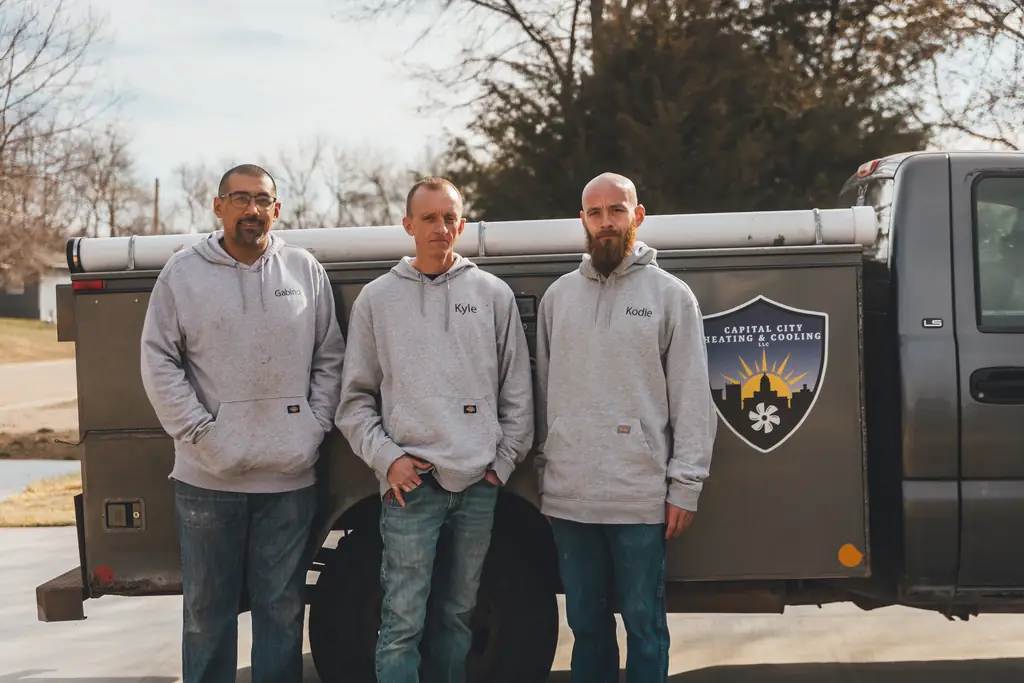
By Kyle Smith's crew at Capital City Heating & Cooling, Topeka, KS. 6 minute read.
Unfamiliar furnace smells and noises deserve attention in your Topeka home. If you smell gas or burning, see sparks, suspect an electrical problem, or hear a carbon monoxide alarm, leave immediately. Call 911 or the gas company from outside. Do not investigate the furnace or delay leaving to open windows.
Furnace smells and noises in Topeka homes
The timing of a new sound can help a technician narrow the cause. A noise during ignition, when the burner lights, suggests different checks from a noise that continues whenever air moves. Describe what you already noticed without running the furnace again to reproduce it.
A sound or odor cannot prove which part failed. Similar noises can come from different moving parts, loose connections, or metal ducts. Keep the furnace panels closed and leave internal diagnosis to a technician. If an unfamiliar mechanical noise is loud or worsening, turn the system off and arrange an inspection. An odor, alarm, or suspected electrical hazard requires leaving the home first.
Why does my furnace smell like burning in fall?
Dust on heated surfaces can cause an odor after a furnace has sat unused. A homeowner cannot reliably distinguish that odor from overheating equipment by smell alone. Do not assume a burning smell is harmless or keep running the system to see whether it clears. Leave the home and call 911 or the gas company from outside.
Tell the responder when you first noticed the odor and whether the furnace had recently started. Mention any smoke or alarm you already observed. Do not return to collect the furnace model number or to switch equipment off. Wait until emergency responders say you can enter safely.
Once the immediate hazard has been assessed, a technician can inspect the furnace before further operation. Dust, restricted airflow, and overheated components require different responses. Waiting several days for an unexplained burning smell to disappear can delay needed attention.
What does a rotten egg or sulfur smell mean?
A rotten egg or sulfur odor can indicate a gas leak and requires immediate evacuation. Utilities add an odorant to natural gas to help people notice leaks. Treat a suspected leak as an emergency even when the smell is faint or its source is uncertain.
Get everyone outside, including pets if they are immediately accessible. Avoid flames, electrical switches, and phone use inside the home. Call 911 or the gas company once outside and away from the suspected leak. Stay out until emergency responders or the gas company say it is safe to return.
Do not test the furnace, search for the leak, or adjust a gas valve. Opening windows is not a substitute for leaving. A smell that fades also does not establish that the building is safe. Let the emergency crew assess conditions before anyone resumes normal use of the equipment.
What causes banging or popping noises?
Duct metal can expand and contract as its temperature changes, producing ticks or pops. Changes in air pressure can also flex metal duct surfaces. Those explanations do not establish that a new bang is harmless. Its source and timing need assessment, especially if the sound occurs as the burner lights.
A bang during ignition can suggest delayed ignition, where gas ignites later than intended. Turn the system off and call a technician. Do not restart it to record the sound or demonstrate it. If you also smell gas or burning, leave the home and call 911 or the gas company from outside.
Describe whether the sound seemed to come from a room vent or from the furnace area. A technician can inspect the duct connections and heating sequence to confirm the cause. Leave panels and internal parts untouched while waiting for service.
Why does my furnace squeal or screech?
Squealing can suggest a problem with a motor, its bearings, or a belt on equipment that uses one. Bearings support a rotating shaft. The blower, the fan that moves household air, is one possible source of this sound. A technician must identify the source before recommending a replacement part.
A short squeal does not prove normal wear, and a continuous squeal does not prove a particular motor has failed. Turn off equipment with a new persistent squeal and arrange service. Report whether the sound started suddenly or grew louder over time.
Do not add oil, tighten a belt, or reach into the fan assembly. Some motors have sealed bearings and are not intended for lubrication. A technician follows the equipment manufacturer's service instructions after identifying the motor and its condition.
What causes rattling, clicking, or grinding?
Rattling can come from a vibrating duct connection or a loose component. Clicking can occur as the furnace controls switch between stages of operation. Some ignition systems also click as they create a spark. Repeated clicking with no heat needs diagnosis, particularly if the furnace keeps attempting to start.
Grinding suggests that moving parts may be contacting each other or that a bearing needs attention. Shut the system off and call a technician for a new grinding sound. Continuing to run it can worsen mechanical damage. Avoid opening a panel to locate the moving part.
An ordinary operating hum cannot confirm that every motor component is healthy. If a hum changes abruptly or the fan stops moving air, report both observations. Sparks, a burning odor, or suspected electrical trouble require leaving the home and calling 911 or the gas company from outside.
Is a yellow or orange burner flame a problem?
An unusual flame appearance needs professional assessment, but color alone cannot establish whether combustion is safe. Combustion means the burning of fuel. A technician evaluates the burner and the exhaust system using the manufacturer's procedures and appropriate instruments.
Do not open a panel to look at the flame, and never light the burner by hand. If you already noticed an abnormal flame through an existing viewing window, stop using the furnace and arrange service. Report the observation without attempting to adjust the flame. Leave immediately for any gas or burning smell or carbon monoxide alarm, and call 911 or the gas company outside.
What should I do if my carbon monoxide alarm sounds?
Leave immediately and call 911 from outside. Carbon monoxide is a poisonous gas with no color or smell. Do not wait for an odor or visible smoke, and do not silence the alarm and resume using the furnace. Stay outside until responders say it is safe to return.
After responders assess the home, a technician can investigate equipment identified as a possible source. A blocked exhaust passage or damage to the heat exchanger can require attention. The heat exchanger is the metal passage that separates combustion gases from household air. A furnace with a cracked exchanger must remain off until the problem is corrected.
Follow the alarm manufacturer's instructions for testing, batteries, and replacement. Check the device label and manual for its required replacement date. A quiet alarm does not replace a furnace inspection or establish that an unfamiliar smell is safe.
Scheduling an inspection
We service all makes and models of residential furnaces in Topeka. Call Capital City Heating & Cooling at (785) 221 9760 Monday through Friday, 8 AM to 5 PM, or book online. Describe the noise and whether you have already turned the furnace off. For a gas smell, burning smell, or carbon monoxide alarm, contact emergency help from outside first.