
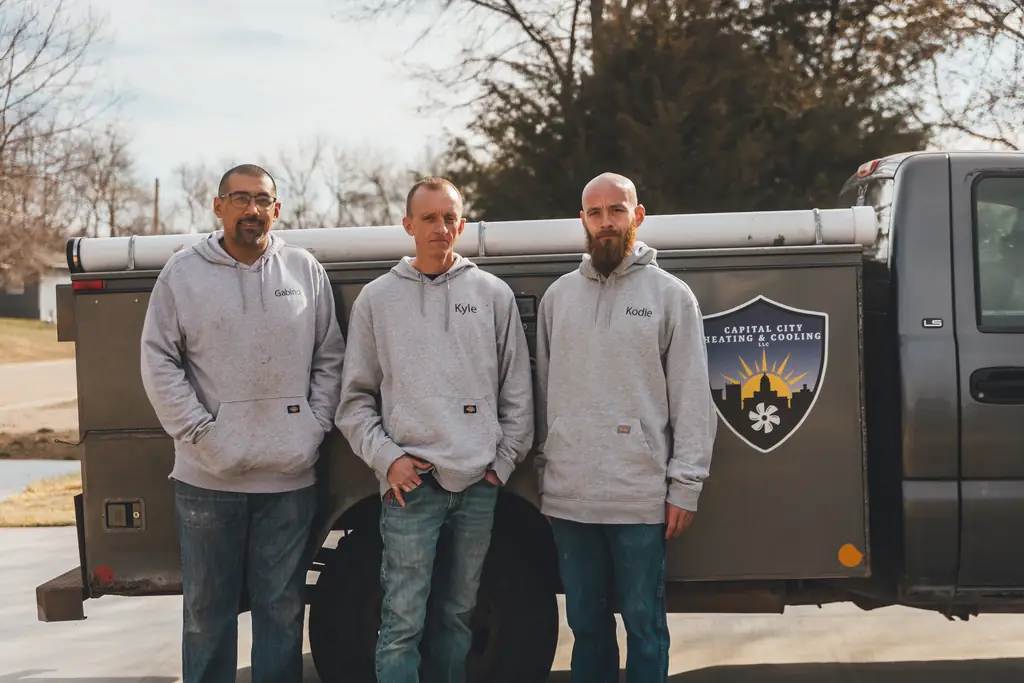
By Kyle Smith's crew at Capital City Heating & Cooling, Topeka, KS. 6 minute read.
A furnace not heating needs attention during a cold Topeka winter. Start with thermostat settings and safe external checks. If you smell gas or burning, see sparks, suspect an electrical problem, or hear a carbon monoxide alarm, leave the home. Call 911 or the gas company from outside. Do not stay inside to find the source or restart the equipment.
Furnace not heating in Topeka
A running fan does not prove that the furnace is producing heat. The blower, the fan that circulates air through your rooms, can run while the burner is off. A thermostat fan setting of On can explain air movement between heating cycles. Set the fan to Auto for operation controlled by the system.
If the house keeps getting colder while the thermostat calls for heat, arrange service. Note whether air reaches every room or only some rooms. Weak airflow throughout the house points a technician toward different checks than a single cold bedroom. You can gather that information from occupied rooms without opening the furnace.
How a furnace heats your home
The thermostat sends a request for heat when the room temperature falls below its setting. On many gas furnaces, a small exhaust fan starts first. A pressure switch, a safety control that responds to pressure in the venting system, helps verify conditions before ignition. The exact startup sequence depends on the furnace model.
The igniter lights the gas at the burner. A flame sensor detects whether the gas has ignited, and the control board coordinates the sequence. Without a confirmed flame, the controls stop the gas flow.
Heat passes through the walls of the heat exchanger, a metal passage that separates combustion gases from household air. The blower normally starts after ignition and moves room air over those heated surfaces. Warm household air travels through supply ducts to your rooms. Combustion gases leave through a separate exhaust vent.
When the thermostat stops requesting heat, the burner shuts off. The blower normally continues for a period to carry remaining heat into the house. This delay varies by equipment and explains why airflow can continue after the burner stops.
Safe thermostat and filter checks
Check that the thermostat is set to Heat and that its temperature setting is above the room temperature. Review any programmed schedule or temporary hold that might lower the setting. For a blank display, follow the thermostat manual for battery replacement if it uses batteries. Leave wiring and internal controls to a technician.
Check the filter according to the equipment instructions. Turn the system off first, and use only a filter location intended for homeowner access without removing a furnace panel. If reaching the filter requires opening the furnace, ask a technician to handle it. Do not operate the system without its filter.
A filter loaded with dust can restrict airflow. That restriction can raise the temperature inside the furnace until a safety control stops the burner. Compare the filter's condition and replacement schedule with the manufacturer's instructions. Holding it against a light does not reliably show whether it needs replacement.
Use the specified filter size and type. Thickness, airflow resistance, and the equipment's requirements matter along with dimensions. Follow the airflow arrow and the installation instructions. Check the filter every month during use, with replacement timing based on the filter instructions and its condition.
Keep supply vents and return grilles clear of furniture and curtains. Supply vents deliver conditioned air; return grilles provide a path back to the furnace. A blocked return can reduce circulation across several rooms. Closing many supply vents can also restrict airflow, so leave them open.
How do I safely reset my furnace?
Follow your furnace manual and limit any permitted reset to one attempt. Do not use repeated thermostat changes or power cycling to force the burner to light. A safety shutdown needs a diagnosis if it returns. Leave equipment off when someone has shut it down for a fault or service.
If the manual is unavailable or the reason for the shutdown is unclear, call a technician before restarting. A reset that restores heat temporarily does not establish that the cause has disappeared. Tell the technician about the shutdown even if the furnace later seems to work. Never bypass a safety control or light the burner by hand.
Why is my furnace running but not producing heat?
Possible causes include thermostat settings, restricted airflow, failed ignition, or a safety shutdown. A technician follows the furnace's actual operating sequence to locate the interruption. The symptom alone cannot identify which part needs replacement.
An igniter can wear or crack, preventing ignition. A dirty or damaged flame sensor can prevent the controls from confirming a flame. A limit switch, a safety device that responds to excessive temperature, can stop heating when airflow is inadequate. Reset behavior varies by furnace, and the cause of overheating must be corrected.
The blower motor can also fail to move enough air. A technician checks its operation and the airflow path before deciding whether the motor needs replacement. Internal gas and electrical tests require training and suitable instruments. Keep panels closed while waiting for service.
Is cool air at startup normal?
A brief cool sensation at a room vent can occur as air already in the ducts moves into the room. The blower normally starts after ignition and keeps running after the burner stops. Persistent cold airflow while the home loses temperature needs service. Avoid using a fixed number of seconds to judge every furnace because operating delays differ.
Why is my furnace running but not blowing air?
The blower may be waiting through its normal startup delay, or there may be an airflow or motor fault. If air never arrives and the home stays cold, turn the system off and call. Do not keep restarting it after an overheating shutdown. Report any filter change and whether airflow was weak before it stopped.
Repair or replacement
Furnaces typically last about 15 to 20 years, with condition and maintenance affecting service life. Age alone does not identify a failed part. Repair decisions depend on the confirmed fault, replacement part availability, and the condition of the rest of the equipment.
A cracked heat exchanger is a safety problem, and the furnace must stay off. A technician can assess whether replacing the exchanger is practical or whether replacing the furnace makes more sense. A crack does not automatically require an entirely new furnace. Ask for an explanation of the fault and the available repair options.
Arranging furnace repair
We provide residential furnace repair in Topeka and service all makes and models. For no heat calls during office hours, in most cases we can get to you the same day. Call Capital City Heating & Cooling at (785) 221 9760 Monday through Friday, 8 AM to 5 PM, or book online.
When you call, describe what the thermostat shows and whether air reaches the vents. Mention any shutdown or reset already attempted. If the home becomes too cold while heat is unavailable, move to a warm place while you arrange help.