
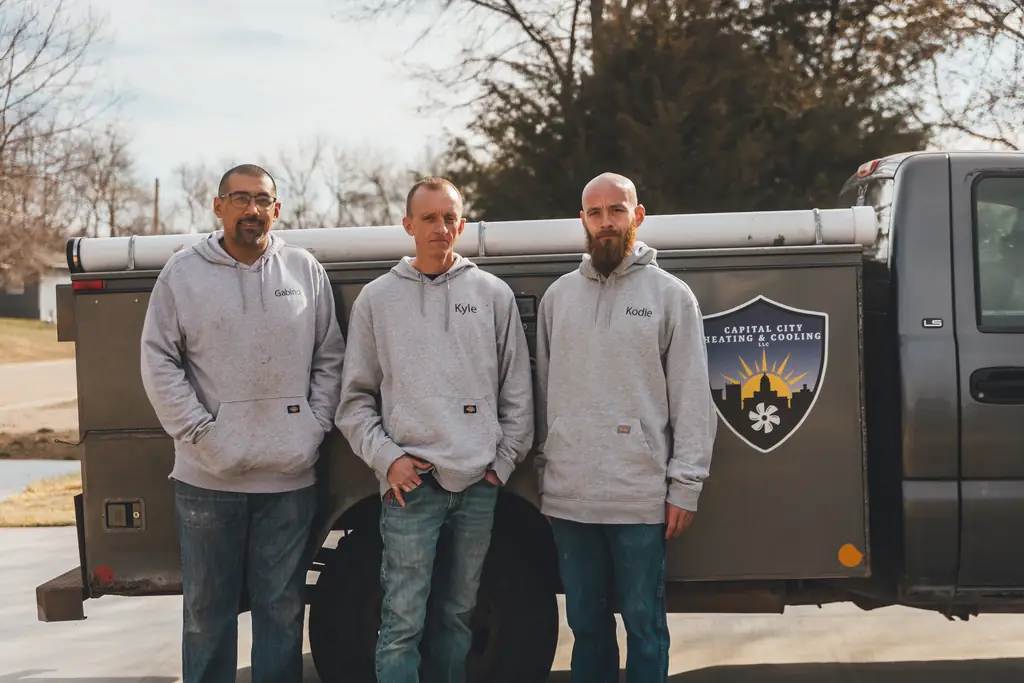
By Kyle Smith's crew at Capital City Heating & Cooling, Topeka, KS. 6 minute read.
For an AC not cooling your Topeka home, check the filter and thermostat settings first. If you see ice on the equipment, turn the cooling off and call for service. A running indoor fan can move air through the rooms even when the air conditioner is not removing heat.
Common reasons for an AC not cooling
A dirty filter or blocked vent can restrict airflow. Other causes include dirt on the outdoor coil, low refrigerant, or a motor that is not running properly. Refrigerant is the fluid that carries heat from inside your home to the outdoor unit. A technician needs to distinguish an airflow problem from a fault in that refrigerant circuit.
Your system removes heat in stages. The indoor blower, a fan inside the furnace or air handler cabinet, moves room air across a cold coil of tubing. Refrigerant absorbs heat there and carries it outside. The outdoor coil releases that heat as its fan moves air across the tubing and metal fins.
A fault at either end can leave the house warm. Notice whether the airflow feels weak throughout the house or whether one room has the problem. Tell the technician whether the cooling stopped suddenly or weakened over time. Those observations help narrow the inspection without opening any equipment.
Safe checks at home
Check the air filter and vents
Turn the system off and check the filter through its designated homeowner access slot or return grille. Follow the equipment manual and leave equipment panels closed. If you cannot reach the filter through a user access point, ask a technician to check it.
Replace a filter loaded with dust or lint using the type and size approved for your equipment. Looking through it toward a light does not reliably show whether it needs replacement. Follow the filter manufacturer's replacement guidance and the equipment requirements. A different filter can restrict airflow even when it fits the same slot.
Keep supply vents, which deliver cooled air, and return grilles, which draw air back, clear of furniture and curtains. Closing vents in unused rooms can reduce total airflow through the system. A room with a closed door also needs a return path, such as a gap below the door or another designed opening.
Check thermostat settings
Set the thermostat to Cool and choose a target temperature below the current room reading. Check for a schedule or temporary setting that changes your selection. For normal cooling operation, the Auto fan setting lets the controls run the indoor fan as needed. The On setting can circulate air even when cooling has stopped.
Allow the manufacturer's restart delay before deciding that the outdoor unit has failed to start. About three to five minutes is typical advice, but the delay depends on the equipment. Avoid repeatedly switching the system off and on. If it still does not start, call a technician. Leave equipment off when someone has shut off its power for repair or safety.
Look around the outdoor unit
With the system off, clear loose leaves and branches from the ground around the cabinet. Follow the clearance specified in the equipment manual. Keep plants away from air openings and leave space above the unit for its airflow.
Do not reach through the grille, touch the fins, or try to straighten them by hand. A technician can assess bent fins and select a cleaning method for the coil. Cleaning does not always require chemicals, and the right method depends on the equipment and the buildup.
Capacitors and fan motors
A capacitor is a component that helps some motors start or keep running. Its function depends on the motor and system design. A failed capacitor can interfere with fan or compressor operation. The compressor is the outdoor part that pumps refrigerant around the system.
The outdoor fan runs according to the equipment controls. Its operation and speed vary by design. If the system is trying to cool and you hear unusual humming while the fan stays still, turn the cooling off and call. That observation can suggest a motor, capacitor, or control fault, but sound alone cannot confirm which part has failed.
Leave these components to a technician. Do not push the fan blades, remove a panel, or handle wiring. For sparks, a burning smell, or other signs of an electrical problem, leave the home and call 911 from outside. A gas smell or carbon monoxide alarm also means leave and call 911 or the gas company from outside.
Ice on the indoor unit or copper lines
Turn the thermostat to Off if you see ice, and let it melt naturally. Do not scrape the tubing or pour hot water over the equipment. Call for service without waiting for the thaw to finish, and keep cooling off until the cause has been checked.
Restricted airflow can make the indoor coil cold enough to freeze moisture on its surface. As ice builds up, it blocks more airflow. A refrigerant problem can also cause freezing. Continuing to run the cooling under those conditions can damage the compressor, though ice alone does not establish that damage has occurred.
Watch for meltwater on the floor near indoor equipment without opening panels. Mention any leaking water when you call. Stay away from wet wiring and follow the emergency guidance above if water reaches electrical parts.
Low refrigerant and pipe temperatures
Refrigerant is not used up in normal operation. A low charge, meaning too little refrigerant in the system, can come from a leak or an earlier undercharge. A technician uses measurements and, when needed, leak testing to identify the problem.
A split air conditioner has separate indoor and outdoor units. Its larger insulated copper line carries cool refrigerant gas back to the compressor. The smaller liquid line is normally warmer. Different temperatures between these lines are expected. You do not need to touch them, and their temperatures alone cannot tell you how much refrigerant is present.
Liquid refrigerant normally enters the indoor coil and evaporates as it absorbs heat. The technician interprets pressures and temperatures alongside indoor airflow and operating conditions. Adding refrigerant without finding the reason for poor cooling can leave the original fault unresolved.
Uneven cooling, equipment size, and age
Ducts are the passages that move air between the equipment and rooms. Leaking supply ducts can release cooled air into a basement or crawl space before it reaches the living area. A crushed duct or blocked opening can also reduce delivery to one room. A technician can inspect accessible ductwork and assess airflow.
Your home's cooling load is the amount of heat the system needs to remove. Sun through windows, air leaks, and outdoor conditions affect that load. Equipment capacity is how much heat the air conditioner can remove under specified conditions. There is no single outdoor temperature difference that limits every home's cooling.
Close sun facing blinds and keep exterior doors and windows shut while cooling. A technician can assess insulation, air leakage, ductwork, and equipment capacity if the house remains warm. Describe additions or changes to the space so the assessment reflects the home as it is now.
Central air conditioners typically last about 10 to 15 years. Age alone does not diagnose poor cooling or make replacement necessary. Compare the condition of the equipment and the required repair before deciding. A dirty filter or blocked coil can affect a newer system too.
Calling for cooling service in Topeka
Call Capital City Heating & Cooling at (785) 221 9760 if cooling does not return after the safe checks, or book online. We are open Monday to Friday, 8 AM to 5 PM. Outside Topeka, ask us about service. For an emergency no AC call during office hours, in most cases we can get to you the same day.
If the home becomes dangerously hot, move to a cooler place while waiting for service. Fans do not make an overheated person safe. Call 911 for confusion, fainting, or vomiting during extreme heat.